Sustainable Comfort · Bedding & Decor
Styling Organic Decorative Pillows: Texture, Scale, and Care with Coyuchi Covers
A considered pillow arrangement does more than soften a sofa or finish a bed. It brings together texture, proportion, color, and touch—while the fibers beneath the surface tell another story about how a home is made and maintained.
Published November 22, 2026
A decorative pillow is a small landscape of fabric. Across its surface, a raised knit can catch the light like a furrowed field; a linen weave may show the irregular trace of its flax fibers; a smooth cotton cover can offer a quiet interval between more tactile forms. Seen together, pillows create rhythm—soft edges against a straight-backed sofa, a broad square beside a narrow lumbar shape, a pale field interrupted by one deeper tone.
That rhythm is not built by pattern alone. In many rooms, the most lasting arrangements rely on a measured mix of texture and scale rather than a crowd of competing prints. Organic cotton and linen covers can contribute a naturally varied surface, but the label is only one part of the decision. The size of the cover, the fit of its insert, the construction of its closure, and the care it requires all affect how it looks and performs over time.
For anyone exploring organic decorative pillows, the useful questions are practical as well as aesthetic: What is the cover made from? Does it come with an insert? How will the fabric change with washing and use? And can the cushion be refreshed or reused rather than replaced? Answering those questions makes it easier to create a comfortable room with a lighter, more deliberate hand.
Begin with proportion, not a pile of pillows
Scale is the quiet structure of a pillow arrangement. A large square cushion can anchor the composition on a deep sofa or broad bed, while a smaller pillow adds a point of contrast. A lumbar cushion introduces a horizontal line, which can break up a row of squares and give the eye somewhere else to travel. The effect resembles a simple composition in nature: broad forms establish the ground, and smaller details create interest.
Before selecting covers, look at the furniture itself. A narrow apartment sofa may feel crowded by numerous oversized cushions. A deep sectional can absorb larger pillows without losing its usable seat. On a bed, the headboard, mattress width, and bedding layers all shape how many pillows feel balanced. The goal is not to meet a fixed number but to leave room for people to sit, lean, and sleep.
- For a compact sofa: Start with a small number of cushions that leave clear seating space. A larger square at one end and a smaller or lumbar shape nearby can be enough.
- For a deep sofa: Larger covers can hold their presence against generous proportions. Varying the shape helps keep the arrangement from looking like a uniform row.
- For a bed: Consider the width of the mattress and the height of the headboard. Decorative pillows should complement the sleeping pillows, not make the bed difficult to use.
- For a reading corner: Choose cushions with useful support as well as a pleasing surface. A pillow that shifts constantly may be less comfortable than one with a stable, well-matched insert.
Dimensions matter most at the point where the cover meets its insert. A cover that is too large for its insert may look slack, with softened corners and folds that obscure its shape. An insert that is much too large can strain seams and closures or make the cushion feel rigid. Check the stated measurements before combining a cover and insert, and pay attention to whether a seller gives the cover’s finished dimensions or a suggested insert size. Those details can differ.
Build contrast through texture
Texture gives a room depth even when its palette is restrained. Pairing a substantial woven cover with a smoother cotton or linen surface creates contrast without introducing a busy pattern. Ribbed or seed-stitch knits bring relief to a flat plane; a herringbone weave adds a fine directional pattern; washed linen can look relaxed and gently rumpled; sateen has a smoother, more even face.
When several pillows share similar colors, touch becomes a kind of visual language. A hand naturally reads the raised and recessed parts of fabric, and the room feels layered even from a distance. To keep the arrangement composed, repeat one quality across more than one pillow. For example, two covers might share a warm neutral shade while differing in weave, or several may have a similar tactile weight while varying in color and shape. Repetition provides a thread of continuity; variation keeps it from becoming monotonous.
Organic cotton covers span a wide range of constructions. A textured herringbone weave feels different from a ribbed knit, even though both may be made from organic cotton. Linen has its own character: it is woven from flax fiber and often shows small irregularities that give the cloth a relaxed, natural appearance. A fabric’s hand depends not just on the fiber name but on how it has been spun, woven or knitted, finished, and washed.
That is why fabric descriptions are more useful when they explain construction as well as material. Look for terms such as slub yarn, matelassé, jersey, sateen, or ribbed stitch, and consider what each may mean in the room. A slub yarn can create visible variation in thickness. A knit may feel soft and flexible. A tightly woven cover can look crisp and hold a defined shape. None is universally best; the right choice depends on the furniture, the intended use, and the atmosphere you want to create.
Choose a restrained color story
Color connects the pillows to the rest of a room: the wood grain of a table, the shadow beneath a chair, the shifting tones of a rug. Organic fabrics are not limited to undyed or neutral shades, but a thoughtful palette can help their texture take center stage. Begin with the largest surfaces already in the room, then choose pillow colors that echo or gently contrast with them.
A tonal arrangement uses several related shades—perhaps a pale stone, a deeper brown, and a muted green. Because the colors are close, differences in weave and scale become more noticeable. A contrasting arrangement can be equally calm if one stronger shade is used sparingly. A single deep accent among soft neutrals often has more presence than several equally bright colors competing for attention.
Try placing the covers together in daylight as well as evening light. Natural fibers can show subtle changes in tone across a textured surface, and indoor lighting may warm or cool a color. If possible, view samples beside the sofa or bedding rather than judging them in isolation. A color that looks quiet on a screen can appear much more saturated against a pale wall—or almost disappear beside a similar upholstery fabric.
Understand what “organic” tells you
“Organic” is a meaningful word when it is backed by clear information, but it does not describe every part of a finished pillow automatically. A cover may be made with organic cotton, while its insert contains a different material. A product may describe its fabric as certified, but it is still worth checking which material the certification applies to and whether the finished product is included in the claim.
For textiles, certification names can help shoppers understand what has been assessed. GOTS, or the Global Organic Textile Standard, is associated with organic fibers and defined processing requirements across certified textile supply chains. Other standards address different questions. A material certification is not a general guarantee of comfort, durability, or a particular environmental outcome. Read the product details carefully, and distinguish between a claim about fiber, a claim about processing, and a claim about the whole finished item.
It is also useful to separate material information from broad language such as “natural,” “green,” or “eco-friendly.” These terms can describe many different things and do not necessarily identify a standard. More specific details—fiber composition, country of origin, construction, care instructions, and the scope of a certification—give a clearer basis for comparison.
With Coyuchi organic cotton and linen covers, as with any textile, the details of the individual cover matter. Some designs are described as GOTS certified; others provide information about where the flax or cotton was grown, where the fabric was woven, and how the cover closes. Those details can help a reader understand a product’s material journey, but they are not substitutes for checking the specific certification and care information for the cover in question.
Cover and insert: a pair that shapes comfort
A decorative cover determines much of a pillow’s visible character, but the insert determines how it fills the fabric and behaves when someone leans against it. A resilient fill can help a cushion regain its shape after use. A softer fill may feel inviting for lounging but require more frequent plumping. Some inserts are designed to be molded or rearranged; others have a more stable form.
Check whether the cover includes an insert or is sold separately. If it is a cover only, confirm the dimensions and the recommended insert size before buying or reusing one at home. Also consider the shape: a square cover needs a square insert, while a lumbar cover needs an insert designed for its longer proportions. These seem like small details, but they influence whether the finished pillow looks full and sits comfortably.
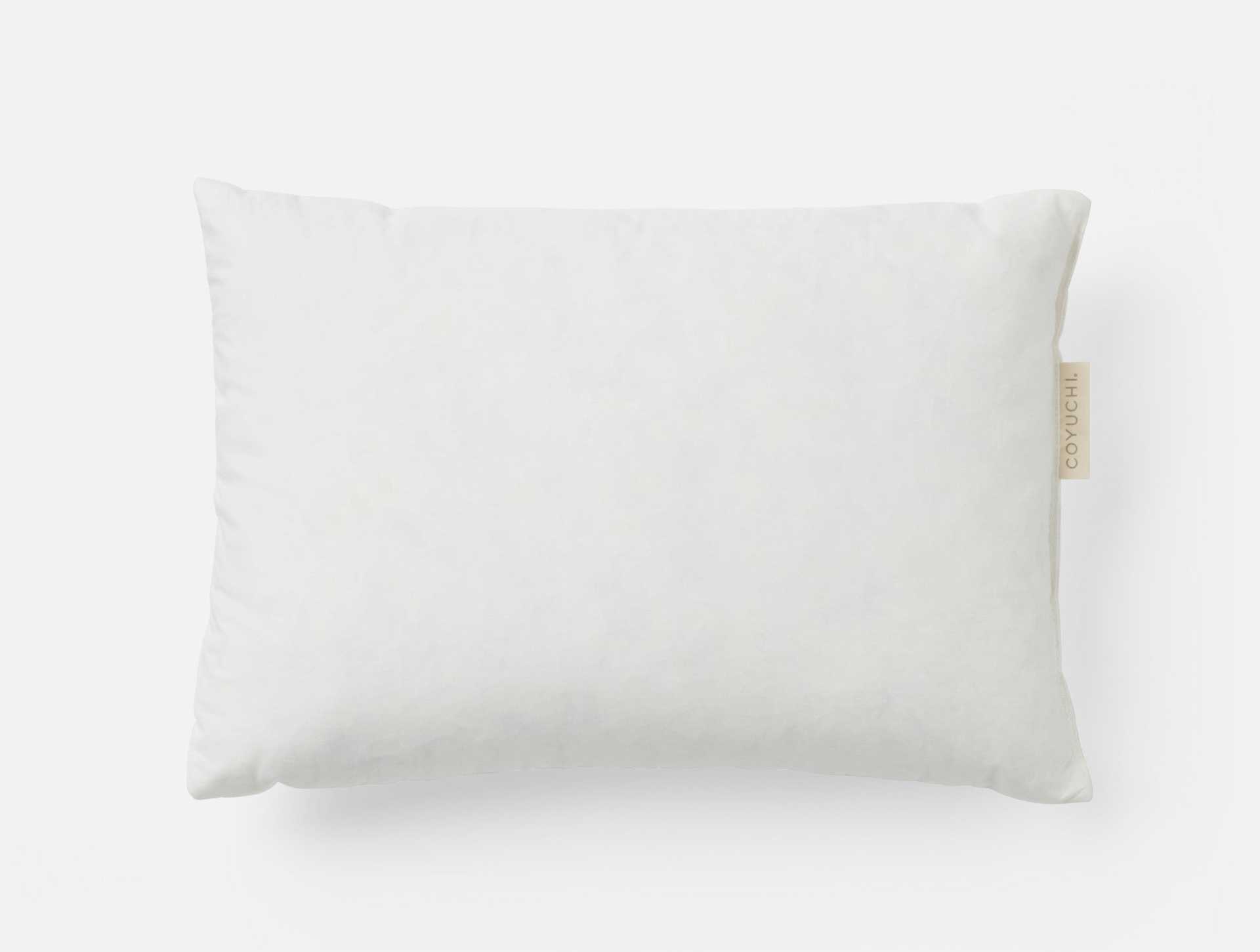
For a decorative cushion, a recycled fill can be one way to extend the useful life of existing materials. The Recycled Feather Down Lumbar Pillow Insert, for example, is described as containing recycled feathers and down in a GOTS-certified organic cotton shell. It is a lumbar insert rather than a cover, so it is relevant when fitting a compatible cover—not a substitute for checking that cover’s dimensions and instructions. Product specifications should always be reviewed directly, particularly when the insert will be used often or needs particular care.
There is no single fill that suits every person or every decorative purpose. If a pillow is mainly for styling, its outline and how well it holds a cover may be the priority. If it will be used behind the back or under an arm, softness and support become more important. Distinguish between a decorative accent and a pillow intended for sleep: a cover designed for a sofa or bed arrangement may not offer the shape, support, or construction needed for nightly head and neck comfort.
Make care part of the design decision
Care begins before a cover reaches the laundry. A removable cover protects the insert from everyday dust and contact, and a pillowcase or washable outer layer can make regular upkeep easier. Check the care label before washing: organic cotton and linen do not all respond identically, and dyes, weaves, closures, embroidery, and finishing treatments can change the recommended method.
Many decorative covers specify cold water and a gentle cycle, but the instructions for the particular item should take precedence. Avoid assuming that a natural fiber can be washed in any way simply because it comes from a plant. Heat, agitation, and an unsuitable drying method may affect size, texture, or shape. Some fabrics are tumble-dried on low; others benefit from air drying. If a cover is described as dry clean only, follow that instruction rather than testing a home wash.
- Remove the insert before laundering a cover, unless the instructions explicitly say otherwise.
- Close zippers or envelope closures where appropriate, and wash similar colors together.
- Use a gentle approach and avoid unnecessary heat, which may contribute to shrinkage or wear.
- Reshape the cover while it is still slightly damp if the care label allows, then dry it fully before putting it back on the insert.
- Spot clean small marks promptly with a method suitable for the fabric, testing discreetly when instructions permit.
- Do not wash an insert just because its cover is washable; fills often have separate care requirements.
For organic linen, a relaxed surface is part of the material’s character. Washing can soften the cloth, and some linen covers are designed to retain a gently rumpled appearance. If a smoother finish is preferred, the care instructions may allow ironing. For knitted covers, avoid rough handling that can snag or distort the stitch structure. For textured woven covers, use care when removing the insert so corners and seams are not pulled under strain.
Let cushions air between uses when practical, and keep them away from prolonged dampness. Regularly plumping or reshaping an insert can help a cushion keep a more even profile. If a fill is adjustable, follow its specific instructions; opening and redistributing it may be useful, but not every pillow is designed to be opened or altered. A cover and an insert have different care needs, so treating them as a single washable object can shorten the life of both.
Style for use, not only for the photograph
A room is not a still image. Pillows are moved from sofa to floor, stacked for reading, and pushed aside to make space. An arrangement that respects those daily motions is more likely to remain attractive. Keep the most supportive cushion where it is easy to reach. Use delicate or highly textured covers where they will not be constantly rubbed by a rough surface. Consider whether a pale cover will sit beside muddy shoes, pets, or meals, and decide whether its care needs fit the household.
For a sofa, one approach is to place larger cushions toward the corners and let a smaller accent or lumbar shape interrupt the line. On a bed, a few carefully scaled layers can echo the width of the mattress without hiding the bedding. In either setting, leave some open space. Negative space gives the arrangement room to breathe and keeps each cover’s construction visible.
Seasonal changes do not require replacing every pillow. Swapping a cover, moving a cushion to another room, or turning a reversible textile to its quieter side can refresh a familiar setting. Buying covers separately from inserts can also make it easier to keep using an insert when a style changes, provided the size and condition remain suitable. Reuse is not automatically a perfect solution for every material, but extending an item’s useful life is often more resource-conscious than treating it as disposable decor.
A practical checklist before choosing
Use this short checklist to bring appearance, material, and upkeep into the same decision:
- Measure the space: Note the furniture’s width and depth, then select pillow dimensions that leave it comfortable to use.
- Plan the mix: Combine one larger or more tactile surface with a smaller, smoother accent, or vary shapes while keeping a shared color thread.
- Read the material description: Identify the fiber in the cover and, separately, the material in the insert.
- Check certification claims: Confirm what is certified and whether the claim applies to a fiber, a component, or the finished textile.
- Confirm what is included: Find out whether the price and description refer to a cover, an insert, or both.
- Match dimensions: Compare the cover measurements with the insert’s size before assembling them.
- Read care guidance: Choose a fabric whose washing or cleaning requirements suit the way the room is used.
- Consider longevity: Look for sound seams and closures, and think about whether the cover can be reused with another insert or in another room.
A softer kind of sustainability
Sustainable home textiles are not defined by a single fiber or a single label. They involve the material itself, how it is grown or produced, the processing and construction of the finished textile, the care it receives, and how long it remains useful. A well-chosen decorative pillow will not solve the larger challenges of textile production. But asking clear questions about materials, certifications, durability, and care can make each household decision more informed.
Organic cotton and linen covers can bring breathable, tactile surfaces into a living space, while considered scale and restrained contrast allow those materials to be noticed. The best arrangement is not necessarily the most elaborate. It is one that fits the room, invites everyday use, and can be maintained without guesswork.
Start with the proportions of the sofa or bed. Choose a small palette, then let weave and touch provide variety. Match each cover to an appropriate insert, verify the specific material and certification details, and follow the care instructions for both pieces. In that quiet sequence—from fiber to surface, from surface to room—decor becomes more than a finishing gesture. It becomes a way of making comfort last.