Pillows · Materials and care
Cotton-Covered Accent Cushions: Materials, Fill, and Longevity
A decorative cushion can look simple from the outside: a square of woven cotton, a seam, a soft place to lean. Inside, though, its comfort and useful life depend on a chain of decisions—how the cotton was grown and finished, what the insert contains, how the cover is assembled, and whether the cushion can be cleaned, repaired, or refilled.
Understanding these details makes it easier to choose accent cushions for real homes and real routines, not just for a room’s first impression.
A cushion is a small system
Accent cushions soften the hard geometry of a sofa, add a resting place for an arm, and help a room feel settled. They are also compact examples of a much larger textile system. The cotton shell may have travelled from farm to spinning mill to dyehouse and sewing floor; the fill may come from a field, a flock, a rubber tree, or a recycling stream. The zipper, thread, lining, and finish add further materials to the picture.
That complexity is worth noticing because the word cotton on a label tells only part of the story. A cotton-covered cushion might use conventional cotton or certified organic cotton; a tightly woven plain cloth or a textured weave; an undyed finish or a dyed and treated surface. The insert might be filled with down, feathers, wool, kapok, latex, cotton, or synthetic fiber. Each combination behaves differently under pressure, in warm weather, and after repeated cleaning.
For anyone comparing organic cotton throw pillows or other natural-fiber throw pillows, the most useful starting point is not a broad claim such as “natural” or “eco-friendly.” Look instead at the specific materials, construction, care instructions, and evidence behind any certification. A clear account of those details helps reveal both what a cushion offers and what it does not promise.
What a cotton shell contributes
The outer fabric is the part a person touches most often. Cotton is popular for cushion covers because it can be woven into a wide range of weights and textures, from crisp canvas to smooth sateen. A firm weave can help contain loose filling and withstand daily handling. A softer, finer cloth may feel more comfortable against the skin but can be more vulnerable to abrasion, snagging, or wear at the seams.
Thread count is sometimes used as a shortcut for judging fabric quality, but it is not a complete measure of durability. Fiber length and quality, yarn construction, weave, fabric weight, finishing, and sewing all matter. A well-made, moderate-weight cotton cover may perform better in everyday use than a finer fabric with weak seams or a delicate finish. For an accent cushion that will sit on a busy sofa, sturdiness and cleanability may matter more than a particularly smooth hand.
Look at the whole shell. Are the seams straight and securely finished? Is the zipper protected so it will not rub against upholstery? Can the cover be removed without straining the fabric? Is there a lining, and if so, what is it made from? A removable cover can make routine cleaning much easier, but only if its care instructions suit the household. Some cotton textiles can shrink or wrinkle if washed incorrectly, while some covers are designed for spot cleaning only.
Color and finish are practical considerations, too. Dark, saturated colors may show fading in strong sunlight; pale covers can reveal stains more readily. Printed or dyed fabric may require more careful laundering than undyed material. None of these characteristics alone determines environmental impact, but they affect how a cushion ages and whether it remains welcome in a room for years.
Organic cotton: a meaningful term with boundaries
Organic cotton refers to cotton grown under an organic agricultural standard. The exact requirements depend on the standard and the certification involved, but certification is more informative than an unsupported label because it provides a defined framework and a way to verify claims. When a product is described as organic, check whether the claim applies to the cotton fiber, the finished fabric, or the complete textile product. Those are not automatically interchangeable statements.
Some textile certifications address more than farming. The Global Organic Textile Standard, commonly called GOTS, sets criteria across stages of textile processing and includes environmental and social requirements. The scope of a certificate matters: a facility, a material, or a product may be certified under particular conditions. It is reasonable to ask what the certification covers and whether the product’s certificate or transaction documentation can be checked through the relevant certifier.
Certification does not make every other question disappear. It does not, on its own, tell you how long a cushion will last in your home, whether the color suits your room, or whether the fill is suitable for someone with a particular allergy or sensitivity. Nor should a single certification be treated as proof of zero environmental impact. Agriculture, processing, transport, manufacturing, use, and disposal all contribute to a textile’s broader footprint.
For that reason, a useful label is one piece of evidence rather than a final verdict. Compare the shell and fill separately. Ask whether the cover is certified, whether the insert is included, and whether the fill has its own material or sourcing documentation. Straightforward, specific language is generally more useful than a cluster of vague terms such as “green,” “clean,” or “planet-friendly.”
Fill determines the cushion’s character
The insert gives a cushion its shape and changes how it responds when someone leans against it. Two covers made from the same cotton may feel entirely different because one contains soft down and the other resilient latex or dense recycled fiber. Consider where the cushion will be used, how often it will be handled, and whether the preferred feel is yielding, springy, firm, or easy to reshape.
Down and feathers
Down clusters are light and compressible, creating a soft, relaxed cushion that can be fluffed back into shape. Feather blends are often firmer and may hold a more structured profile. These fills are animal-derived, so people who avoid animal materials will want to consider alternatives. Sourcing statements can help explain how the material was obtained, but terms such as “responsibly sourced” should be read alongside the specific standard or verification offered. Down and feather inserts also need thorough drying after washing; damp fill can clump and may develop an unpleasant odor.
Wool
Wool has a springy, insulating structure and can create a cushion that feels supportive rather than cloud-soft. In a decorative insert, wool may be layered as batting or formed into small clusters. The fill’s construction affects whether it can be adjusted and how well it retains loft. Wool cushions are not always machine washable: some should be spot cleaned, with a removable cover washed separately. Care instructions deserve particular attention before purchase.
Kapok and cotton
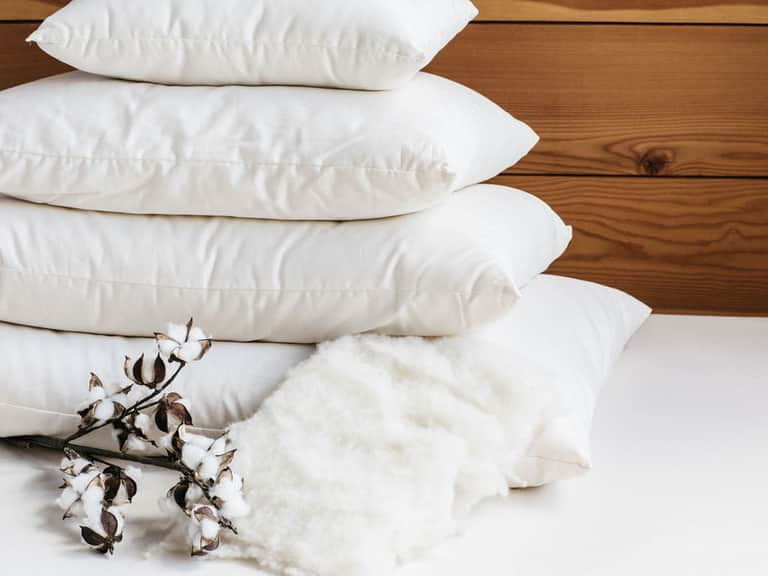
Kapok is a light plant fiber that can produce a soft, airy feel. Cotton fill offers an all-plant-fiber approach when both the fill and shell are cotton, though its density and tendency to settle vary by construction. Neither material is automatically easy to clean or equally durable in every insert. Ask whether fill can be added or removed, whether the insert can be opened, and how it should be refreshed if it compresses over time.
Latex
Latex is resilient and tends to rebound after pressure. Shredded latex can be rearranged or molded more readily than a single molded core, making it a possible choice for a cushion that doubles as back support. It is heavier than many loose fills, and latex inserts are typically spot cleaned rather than machine washed. If latex is under consideration, check the material description and relevant certification carefully; “natural” and “organic” are not synonyms, and claims may apply to different parts of a product.
Recycled and synthetic fills
Recycled feather or down can keep recovered material in use, while recycled polyester and other synthetic fibers can provide a familiar, often easy-to-shape feel. Recycled content is a useful material detail, but it does not by itself describe durability, processing, or the full life-cycle impact. Synthetic fills may shed microfibers during washing, depending on their construction and care. A washable cover, less frequent laundering, and careful maintenance can help reduce wear and unnecessary cleaning.
Construction is where longevity begins
A durable cushion is not simply a cushion made from a durable fiber. Construction determines whether the materials work together under everyday use. Dense, even stitching helps prevent seams from opening. A well-fitted insert fills the cover without creating excessive tension at the corners. A zipper or other closure makes it possible to remove the insert for cleaning or replacement, while a sturdy inner casing can help contain loose fill during adjustment.
Pay attention to the way a cushion will be used. A decorative pillow that stays on a guest bed faces different stresses from one that is constantly pushed against a sofa arm or used by children and pets. For high-use rooms, a tough weave, removable washable cover, and replaceable insert can be more valuable than a delicate finish. In a formal or lightly used space, texture and color may take priority.
Scale matters as well. An insert that is too small for its cover can look slack and shift around; an insert that is too large can strain seams and distort the fabric. A fuller appearance can often be achieved by choosing an insert that fits the cover well, but follow the maker’s sizing guidance rather than forcing an oversized fill into a shell. When a cushion loses shape, gentle fluffing and turning can distribute wear more evenly.
Repairability is an overlooked measure of longevity. A replaceable insert allows the cover to remain in use if the filling compresses. A zipper that can be repaired, a seam that can be resewn, and a cover in a standard size are practical advantages. Before replacing a worn cushion, consider whether the shell can be mended, repurposed, or paired with a new insert.
Care that protects fabric and fill
Care instructions are not fine print to ignore after purchase; they are part of the material’s performance. Start with the label, because different fibers and constructions tolerate different treatment. Remove a cover only if it is designed to come off. Check for stains before washing, close zippers, and avoid mixing colors that could transfer dye. Use a mild detergent and a cool or warm cycle only when the care guidance permits it.
Spot cleaning is often the right approach for inserts that contain wool, kapok, latex, or other fills that should not be soaked. Blot a spill promptly rather than rubbing it deeper into the cloth. Use as little moisture as practical, then allow the area to dry completely with good airflow. Direct high heat can damage some fibers or finishes, so avoid assuming that a cushion can go in a dryer simply because its removable cover can.
Regular light maintenance can reduce the need for intensive cleaning. Fluff or turn cushions periodically, rotate them between seating positions, and keep them out of prolonged direct sunlight where possible. A washable cover or protective layer can help shield the inner cushion from body oils, dust, and spills. For down or feather fills, follow the manufacturer’s drying directions carefully; a cushion that feels dry on the surface may still hold moisture inside.
Storage matters when cushions are seasonal. Clean and dry them fully before putting them away, then store them in a breathable container in a dry place. Sealing a damp cushion in plastic can trap moisture. Avoid compressing delicate fills for long periods, since some may not recover their original loft readily.
A cushion’s environmental profile is more than its label
Choosing sustainable throw pillows involves weighing more than the farming method of the shell fabric. Useful questions include how much of the product is made from renewable or recycled materials, how long it is likely to remain in use, whether the insert and cover can be cared for separately, and what happens when one component wears out before another.
Cotton cultivation and processing require resources, and the effects vary with growing conditions and production methods. Organic certification can establish meaningful standards for the certified scope, but the product still has to be manufactured, transported, used, and eventually managed at end of life. A cotton cover paired with a synthetic insert is not the same material profile as a cushion made entirely from natural fibers; a recycled fill brings another set of considerations. Precise material disclosure makes such distinctions visible.
Durability can be a significant part of a lower-impact choice. A cushion used for many years may avoid repeated replacement, while an inexpensive item that quickly loses shape can become waste sooner. That does not mean the most expensive or most heavily certified option is automatically the best. A well-sized cushion that suits its setting, can be cleaned appropriately, and is likely to be maintained has a practical advantage over a product that is difficult to care for or uncomfortable to use.
End-of-life options also depend on construction. A cover and insert made from mixed materials can be difficult to separate for recycling. Natural fibers may be biodegradable under appropriate conditions, but dyes, finishes, coatings, zippers, and mixed-fiber components affect what can actually happen in a local waste system. Reuse, repair, and donation are often more straightforward than assuming a cushion can be composted or recycled.
A practical checklist before choosing
Whether you are comparing organic cotton throw pillows for a sofa or choosing an insert for an existing cover, a few direct questions can narrow the field:
- What is the shell made from? Look for fiber content, fabric weight or weave details where available, and whether the cover is removable.
- What is inside? Identify the fill and whether it is natural, synthetic, recycled, or a blend. Check whether the percentage of each material is stated.
- What does certification cover? Confirm whether a claim applies to the fiber, fabric, processing, or finished product, and seek verifiable details rather than relying on a logo alone.
- How is the insert constructed? Consider whether it is adjustable, refillable, replaceable, or likely to need regular fluffing.
- How should it be cleaned? Distinguish instructions for the cover from those for the insert. Spot-clean-only construction may not suit every household.
- Will it fit its setting? Match firmness, dimensions, texture, and color to how the cushion will actually be used.
- Can it be repaired? A replaceable insert, robust seams, and accessible closure can extend the useful life of the cushion.
These questions help separate a persuasive description from a useful one. They also make it easier to compare products fairly: a cushion with a washable cotton cover and a spot-clean-only wool insert has different care demands from one whose entire construction can be laundered.
Comfort and longevity are connected
The most sustainable cushion is not necessarily the one with the longest list of material claims. It is one that fits the room, feels comfortable enough to keep, and has a construction that can withstand its intended use. Cotton offers a versatile surface, but the quality of the yarn, weave, seams, and finish will shape how that surface ages. Fill choices influence loft and resilience, while care instructions determine whether a small stain becomes a lasting problem or a manageable task.
In the end, the quiet details matter: a cover that comes off without a struggle, a filling that can be refreshed, a seam that stays closed, a label that says exactly what is inside. Those details turn a decorative object into a useful household textile—one that can move with a room rather than be discarded when the season or style changes.
By examining materials, certification scope, construction, and care together, readers can make more informed choices about cotton-covered accent cushions. The goal is not to find a perfect material with no trade-offs. It is to understand those trade-offs clearly and choose a cushion designed to serve its purpose for as long as possible.